
MIT6.S081 XV6 lab1 util
pingpong
Write a program that uses UNIX system calls to ‘’ping-pong’’ a byte between two processes over a pair of pipes, one for each direction. The parent should send a byte to the child; the child should print “
: received ping”, where is its process ID, write the byte on the pipe to the parent, and exit; the parent should read the byte from the child, print “ : received pong”, and exit. Your solution should be in the file user/pingpong.c.
- Use
pipeto create a pipe.- Use
forkto create a child.- Use
readto read from the pipe, andwriteto write to the pipe.- Use
getpidto find the process ID of the calling process.- Add the program to
UPROGSin Makefile.- User programs on xv6 have a limited set of library functions available to them. You can see the list in
user/user.h; the source (other than for system calls) is inuser/ulib.c,user/printf.c, anduser/umalloc.c.
pipe(管道)用于两个进程间的通信,一个进程写,另一个进程读。pip()用于创建管道,传入一个数组。然后就两个进程可以通过fd进行通信。fork()函数用于创建子进程,从这个函数以下所有的程序都由父进程和fork出来的子进程共同执行。可根据 返回的pid区分父子进程,如果返回的pid>0,则该进程是父进程,如果pid=0,则为fork出来的子进程。
代码如下:
1 |
|
primes
Write a concurrent version of prime sieve using pipes. This idea is due to Doug McIlroy, inventor of Unix pipes. The picture halfway down this page and the surrounding text explain how to do it. Your solution should be in the file
user/primes.c.Your goal is to use
pipeandforkto set up the pipeline. The first process feeds the numbers 2 through 35 into the pipeline. For each prime number, you will arrange to create one process that reads from its left neighbor over a pipe and writes to its right neighbor over another pipe. Since xv6 has limited number of file descriptors and processes, the first process can stop at 35.
- Be careful to close file descriptors that a process doesn’t need, because otherwise your program will run xv6 out of resources before the first process reaches 35.
- Once the first process reaches 35, it should wait until the entire pipeline terminates, including all children, grandchildren, &c. Thus the main primes process should only exit after all the output has been printed, and after all the other primes processes have exited.
- Hint:
readreturns zero when the write-side of a pipe is closed.- It’s simplest to directly write 32-bit (4-byte)
ints to the pipes, rather than using formatted ASCII I/O.- You should create the processes in the pipeline only as they are needed.
- Add the program to
UPROGSin Makefile.
题目大致意思是用pipe和fork函数求2-35之间所有的素数。
求素数方法,第一个进程打印第一个素数,然后删除这个素数以及这个素数的倍数,然后将剩下的数交给下一个进程处理,以此类推。
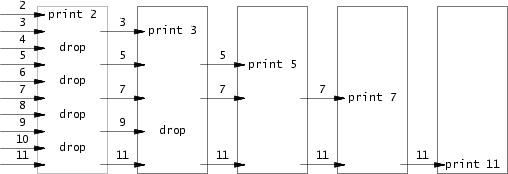
代码如下:
1 |
|
find
Write a simple version of the UNIX find program: find all the files in a directory tree with a specific name. Your solution should be in the file
user/find.c.
- Look at user/ls.c to see how to read directories.
- Use recursion to allow find to descend into sub-directories.
- Don’t recurse into “.” and “..”.
- Changes to the file system persist across runs of qemu; to get a clean file system run make clean and then make qemu.
- You’ll need to use C strings. Have a look at K&R (the C book), for example Section 5.5.
- Note that == does not compare strings like in Python. Use strcmp() instead.
- Add the program to
UPROGSin Makefile.
实现一个unix的find程序,查找匹配的文件。
fmtname函数区最后一级文件名。如a/b/c.txt,则返回值就为cc.txt
大体思路为:读取当前路径下的所有文件,如果为文件,则比对文件名;如果为文件夹,则拼接目录,然后继续遍历文件夹。
1 |
|
xargs
Write a simple version of the UNIX xargs program: read lines from the standard input and run a command for each line, supplying the line as arguments to the command. Your solution should be in the file
user/xargs.c.
- Use
forkandexecto invoke the command on each line of input. Usewaitin the parent to wait for the child to complete the command.- To read individual lines of input, read a character at a time until a newline (‘\n’) appears.
- kernel/param.h declares MAXARG, which may be useful if you need to declare an argv array.
- Add the program to
UPROGSin Makefile.- Changes to the file system persist across runs of qemu; to get a clean file system run make clean and then make qemu.
通过标准输入流读取管道输入,然后将读取的输入作为xargs后面命令的参数。
如:
1 | $ echo hello too | xargs echo bye |
如何读取管道符的输入(标准输入流)
根据实验指导书1.2 I/O and File descriptors:
Internally, the xv6 kernel uses the file descriptor as an index into a per-process table, so that every process has a private space of file descriptors starting at zero. By convention, a process reads from file descriptor 0 (standard input), writes output to file descriptor 1 (standard output), and writes error messages to file descriptor 2 (standard error). As we will see, the shell exploits the convention to implement I/O redirection and pipelines. The shell ensures that it always has three file descriptors open (user/sh.c:151), which are by default file descriptors for the console.
可知,读取标准输入流,只需读取fd=0的描述符即可;如果我们要标准化输出,则向fd=1的描述符写入即可。
exec函数
exec函数共有两个参数,第一个传入执行的命令,第二个传入参数。
大体思路:将xargs的所有参数保存,读取标准输入流,将读取的输入加入到保存的参数中,最后调用exec执行第一个参数,传入所有参数即可。
代码如下:
1 |
|